








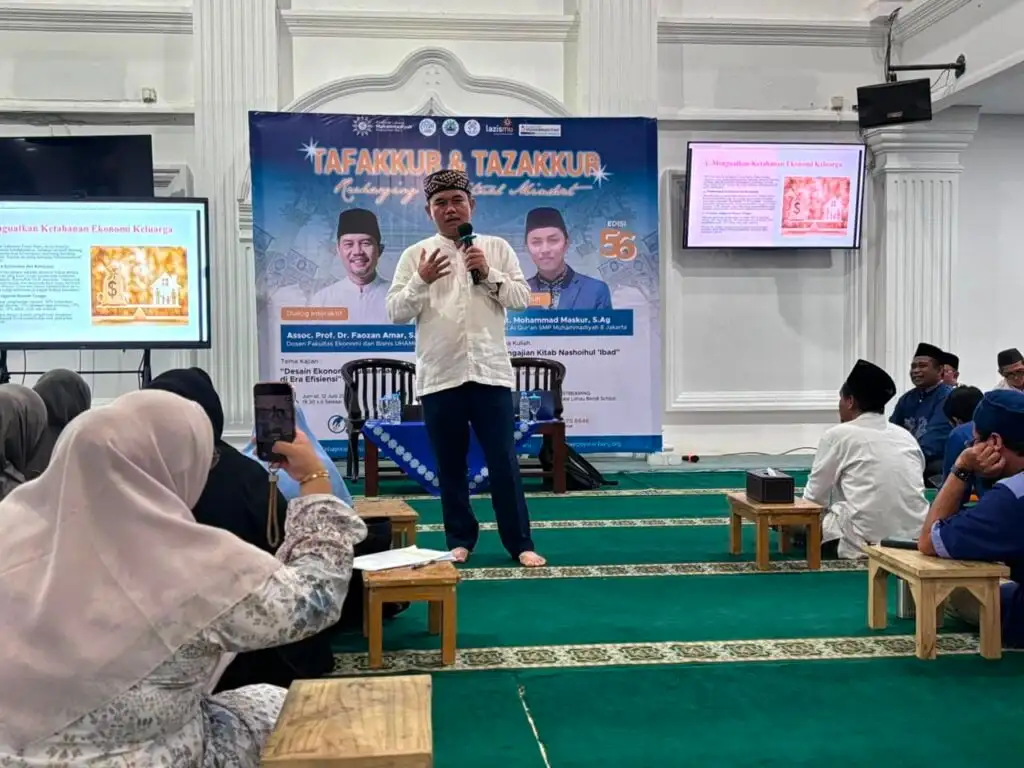
THETIMESNEWS.id | JAKARTA – Deputy Chairman of the Social Welfare Development Council (MPKS) of the Central Board of Muhammadiyah, Faozan Amar, emphasized that the current period of economic efficiency should serve as a momentum for Muhammadiyah members to strengthen their financial independence through a combination of effort, innovation, and spiritual resilience.
“Economic hardship should not be met with complaints alone. It must be addressed through hard work, innovation, and trust in God. Income from Muhammadiyah business charities alone is not enough if we are not creative. This efficiency era is the right moment to strengthen economic self-reliance. If families are financially strong and schools are sustainable, Muhammadiyah will continue to progress,” Faozan stated.
He delivered the remarks during the monthly Malam Bina Iman dan Taqwa (MABIT) program organized by the Muhammadiyah Branch Leadership (PCM) of Kebayoran Baru at At-Taqwa Mosque, Muhammadiyah Education Complex Limau, South Jakarta, on Friday (June 12).
The event carried the theme “Muhammadiyah’s Economic Design in an Era of Efficiency”, addressing the economic challenges currently faced by society, including rising prices of basic necessities, education costs, transportation expenses, and increases in non-subsidized fuel prices that have weakened purchasing power.
In his presentation, Faozan, who also serves as a lecturer at the Faculty of Economics and Business of UHAMKA, outlined four key strategies to strengthen the economic independence of Muhammadiyah members.
First, he encouraged the utilization of Artificial Intelligence (AI) and digital skills to create new sources of halal income. According to him, Muhammadiyah teachers and educational staff must transform into knowledge workers by mastering digital technology, online learning platforms, and educational content production that can generate additional revenue.
Second, he highlighted the importance of strengthening spirituality through piety and charitable giving. Referring to verses from Surah Ath-Thalaq (2–3) and Surah Al-Baqarah (261), Faozan stressed that charity does not diminish wealth but instead opens the door to blessings and greater sustenance. He also advocated reinforcing the spirit of Al-Ma’un by establishing internal social funds and promoting a culture of daily donations within Muhammadiyah communities.
Third, he called for disciplined financial management in line with the Islamic Lifestyle Guidelines for Muhammadiyah Members (PHIWM). Members were advised to avoid excessive consumerism, including the use of pay-later services and unproductive debt. He proposed a financial allocation model consisting of 60 percent for essential needs and 10 percent each for emergency funds, investments, education, and charitable contributions.
Fourth, he emphasized the need to build an independent community-based economic ecosystem through the principle of ta’awun (mutual assistance). This can be achieved by strengthening Islamic cooperatives, creating directories of members’ businesses, and organizing bazaars that encourage economic transactions among Muhammadiyah members.
Furthermore, Faozan underlined three major priorities for Muhammadiyah branch leaderships: safeguarding members’ welfare, empowering community-based micro, small, and medium enterprises (MSMEs), and diversifying the income sources of Muhammadiyah charitable enterprises (AUM) so they are not solely dependent on educational fees.
In addition to the economic discussion, the MABIT event also featured the inauguration of Muhammadiyah local branch leaders (PRM), the handover of appointment decrees for acting school principals, and organizational restructuring within PCM Kebayoran Baru.
PCM Kebayoran Baru Chairman M. Said Matondang explained that MABIT serves not only as a platform for spiritual development but also as a means of consolidating and refreshing the values of Al-Islam and Muhammadiyah ideology among those involved in Muhammadiyah charitable enterprises.
“MABIT serves as a platform for renewing the spirit of Al-Islam and Muhammadiyah values among the leaders and activists of Muhammadiyah charitable institutions. We hope that the spirit of amar ma’ruf nahi munkar (promoting good and preventing wrongdoing) remains strong amid the economic challenges faced by our members,” he said.

Komentar via Facebook